
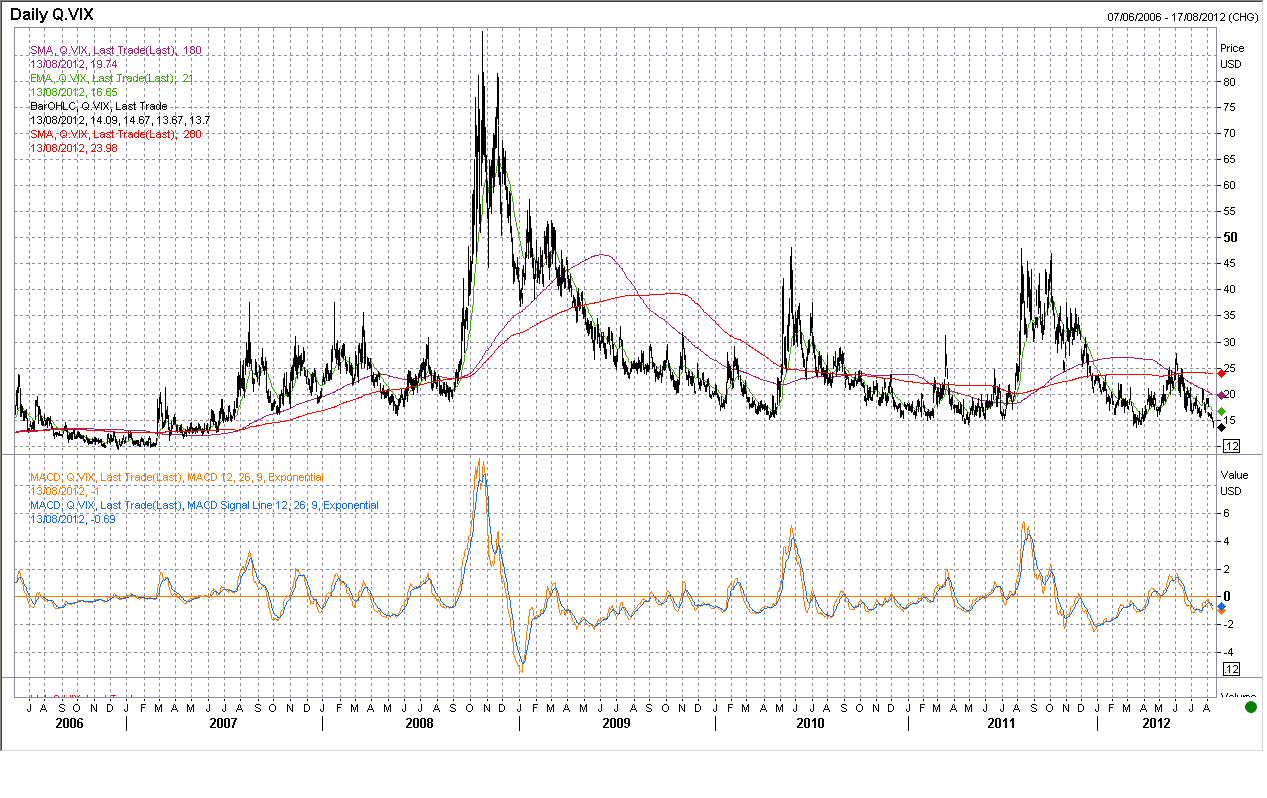
VIX är är nere på lägsta nivån sedan 2007, senast 13,70. Inte skvallrar det om en förestående sättning inte!
Sen kom det lite data från Europa
I EZ sjönk IP med -2,1% YoY mot -2,2 väntat och -2,8 föreg. Juni datan var alltså bättre än både april och maj… vilket får en att undra. ÄR Q2 det sämsta kvartalet.. för att det sen ska bli gradvis bättre?
Det kom även flash estimat över EZ BNP 2Q12 som visade -0,4% YoY mot väntat -0,4 och föreg -0,1. Jodå, EZ befinner sig i recession, och därmed basta! frågan är, återigen, om Q212 är as bad as it gets, och i 3Q12 blir det en liten förbättring?
EZ GDP YoY

I eftermiddag har vi PPI samt retails sales från US


 Kortsikt's Blog
Jag passar på att fylla på med mer säljisar med lång löptid. Är inte redo att ge upp min negativa syn. Låg volla borde ge ganska bra pris. LTG i all ära men jag tror att börsen ska ner rejält inom 6-12 mån. Vissa dagar känns det väldigt rätt att ha denna syn. Andra dagar känns inte alls så bra… Tack för en bra blogg!
Tror också vi ska korrigera… men jag tror också vi kan nå 1183 inom den här horisonten! Inom LTG scenariot är det fortsatt Range bound som gäller!
Jag hör ibland hör är att börsen inte varit ledande för konjunkturen på riktigt länge (ex. missade den nedgången 2007/08). Vad tror ni?
Hur menar du?
OMXs30 toppade 13 juli 2007, visst det var Bear Sterns och annat skit under våren -07 men konjunkturellt var det ett starkt år. 2008 blev ett halvdåligt år konjunkturellt, men det var framförallt 2009 som var det stora recessionsåret globalt. Den 15 september smällde Lehman, och det brukar man ju räkna som startskottet för ”the great recession” (till skillnad från the great depression på 30-talet). MEN, the big MEN, då hade svenska börsen redan gått ner 36% sedan toppen 2007. Visst, det föll på även efter Lehman, eller rättare sagt det föll ytterligare 34% under 1,5 månad !!!!!!!!!! (botten var den 27/10 på 557. Total nedgång 58%). Men trots detta tycker jag ändå börsen var duktig på att prisa in lågkonjan under 2009, med ca 50% av total nedgång. Det tycker jag ändå är en ganska hygglig diskontering av krisen?
För att ta ett framtida exempel. Säg att hela Euro samarbetet skulle skita sig helt. Då kommer marknaden säkert falla med 30-40%. Men det skulle som i alla kriser vara lite Sell the rumours – Buy the facts. troligtvis skulle lågpunkten komma rätt kort tid efter det är ett faktum! Att börsen idag handlas med en riskpremie som är historiskt hög (Equity risk premium = (1/PE)-Riskfria räntan)) är ju ett tecken på att en hel del är taget i priserna.
Tack, intressant synvinkel. Tror många skulle tycka det verkar som att börsen blir tagen på sängen när den faller 34% under 1,5 månad 🙂 Jag kom och tänka på ett citat från Shiller’s bok Irrational Exuberance:
”the stock market has not come down to historical levels: the price-earnings ratio as I define it in this book is still, at this writing [2005], in the mid-20s, far higher than the historical average. … People still place too much confidence in the markets and have too strong a belief that paying attention to the gyrations in their investments will someday make them rich, and so they do not make conservative preparations for possible bad outcomes.”
Börsen har gått upp ca 10% de senaste tre månaderna och om (stort om) börsen är ledande så finns det kanske en förklaring till detta. Kanske blir det inte värre än såhär och att vi i så fall kan stå inför en synkroniserad upturn under våren 2013.
Jan Hatzius verkar dock positiv och kastar in handduken om QE3 under 2012:
The US economic recovery remains sluggish, but we believe that it will pick up a bit in coming months. Tuesday’s data were generally in line with this expectation:
1. Stronger retail sales. The July retail sales report showed a clear upside surprise, with a 0.9% gain in sales excluding autos, building materials, and gasoline. The month-to-month strength was broad-based, with sizable gains in most core categories, although it mainly served to reverse some of the declines in the prior month.
2. Slower inventory accumulation. Inventory accumulation has slowed clearly in recent months, with book-value business inventories up just 0.1% in June, down from a peak of 0.8% in January. We believe that this slowdown has been partly responsible for the disappointing performance in manufacturing surveys such as the ISM and Philly Fed. If it is ending, that should help the manufacturing sector over the next few months.
Our proprietary measures of US economic growth have also picked up a bit further. Our Q3 GDP tracking estimate rose to 2.3% from 2.2%, our current activity indicator (CAI) now stands at 1.2% in July after 1.1% in June, and our US-MAP index of US economic data surprises is moving quickly further toward neutral readings on a 60-day exponential moving average basis.
The recent news on the pace of the recovery also has implications for Federal Reserve policy. To be clear, our own view remains that there is a very solid case for additional accommodation under the Fed’s dual mandate of maximum employment and 2% inflation. And we do believe that Fed officials will ultimately decide to ease policy further.
However, in contrast to a number of other forecasters, we do not expect a move to QE3 at the September 12-13 FOMC meeting. Although Fed officials clearly adopted a strong easing bias at the July 31-August 1 FOMC meeting, we do not think that this amounts to a pre-commitment to QE3. Instead, we believe that continued weakness is necessary to prompt a substantial easing move. And so far, that weakness is not showing up in the data. Among the top-tier indicators released since the meeting, only the July ISM manufacturing index was a (modest) disappointment. In contrast, the July employment report was at worst a split verdict, the July nonmanufacturing ISM was a bit better than expected, jobless claims have surprised on the low side over the past few weeks, the June trade deficit showed an unexpected decline, and the July retail sales report surprised on the upside.
Other factors have also, at the margin, swung against the expectation of aggressive near-term easing. The inflation outlook has become a bit cloudier in the wake of the recent recovery in commodity prices; while Tuesday’s upside surprise on producer prices was largely driven by volatile sectors such as vehicles and tobacco, underlying price pressures were also a touch firmer than we had expected. Moreover, our GS financial conditions index has now fully unwound the tightening seen in the second quarter, and we have found previously that the meeting-by-meeting probability of Fed easing is quite sensitive to financial conditions.
To be sure, the uncertainty around the near-term trajectory of Fed policy remains substantial. Several FOMC meeting participants, specifically Presidents Evans, Rosengren, and Williams, are making the case for additional easing via potentially open-ended balance sheet expansion. And it might well be that Chairman Bernanke will use his speech at the upcoming Jackson Hole Symposium to explain why the Fed’s mandate calls for further accommodation in the near term. We will be receptive to these messages and will review our monetary policy forecasts as needed. But our call remains that the return to QE will not happen until late 2012/early 2013, and at the margin the recent data have made us a bit more confident.
Tack för input